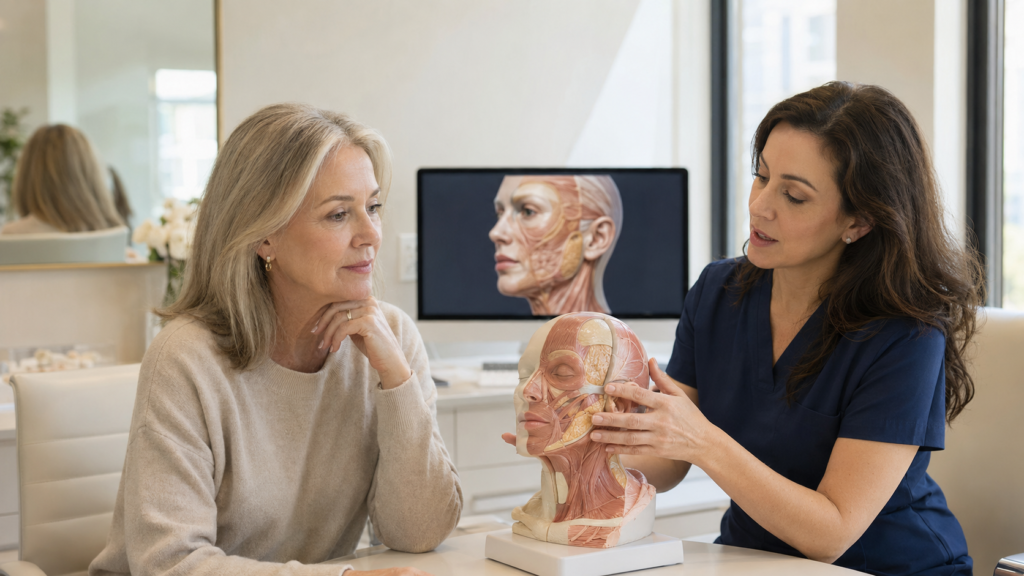

The deep plane facelift has become one of the most discussed cosmetic surgeries in the world. Celebrity transformations, viral before-and-after photographs and promises of unusually natural results have pushed the procedure into mainstream conversation. However, the technology is less new, less standardized and more complex than social media posts often suggest.
Modern facelift surgery no longer relies only on stretching and removing excess skin. Instead, surgeons can reposition deeper supporting tissues, release certain retaining ligaments and restore facial contours with less tension on the skin. Still, “deep plane” does not automatically mean superior, scar-free or permanent.
This guide examines how the operation works, what “muscle repositioning” really means, its costs, recovery, longevity and risks. It also separates verified celebrity disclosures from speculation and analyzes the global facelift market using the latest completed international statistics.
Editorial note: Data and public disclosures were checked through July 15, 2026. This article provides general education, not personal medical advice. Facelift surgery is a major elective operation intended for appropriately assessed adults and is generally unsuitable for teenagers.
Deep Plane Facelift at a Glance
| Question | Evidence-based answer |
|---|---|
| What does it lift? | Primarily the lower face, jawline and, when combined with neck work, the neck |
| Does it simply pull the skin? | No. It repositions a deeper unit that includes the SMAS, attached soft tissue and sometimes the platysma |
| Does it move facial muscles? | That phrase oversimplifies the surgery. Surgeons mainly reposition fibromuscular fascia and soft tissue while preserving facial-expression muscles |
| Is it brand new? | No. Surgeon Sam Hamra formally described the deep-plane concept in 1990 |
| Is it always better than a SMAS facelift? | Current evidence does not prove universal superiority |
| Typical social downtime | Often around two to four weeks, although residual swelling and numbness last longer |
| Final maturation | Commonly six to nine months |
| How long can results last? | Often around seven to twelve years, with considerable individual variation |
| Published U.S. surgeon fee | $12,000 to $19,000, excluding many associated expenses |
| Reported premium deep-plane pricing | Frequently $30,000 to $100,000 in high-cost U.S. markets; exceptional prestige practices may charge more |
| Main risks | Hematoma, infection, healing problems, scarring, asymmetry, sensory changes and temporary or, rarely, permanent nerve injury |
| Worldwide procedure estimate | 737,028 facelifts in 2024 |
| Growth from 2023 to 2024 | 7.4% |
| Growth from 2020 to 2024 | 75.9%, although the pandemic-distorted 2020 baseline exaggerates the long-term trend |
Sources: ASPS 2024 fee data, ISAPS 2024 Global Survey, NHS facelift guidance and StatPearls clinical review.
Why the Deep Plane Facelift Suddenly Became Famous
Social media made facelift surgery visually dramatic and commercially powerful. A celebrity can appear with a sharper jawline, smoother neck and preserved facial character, triggering millions of searches before anyone confirms what happened.
Meanwhile, surgeons have shifted their marketing language. During earlier decades, clinics often promoted “mini lifts,” short scars and minimal downtime. Today, many emphasize deeper anatomy, ligament release, facial preservation and structural repositioning.
Several trends support the renewed interest:
- Patients increasingly request natural-looking movement rather than visibly tight skin.
- High-resolution cameras expose contour changes that makeup cannot fully disguise.
- Some people want a longer-lasting alternative to repeated injectable treatments.
- Weight changes associated with aging or GLP-1 medications can reveal facial laxity and volume loss.
- Surgeons now share educational videos that make complex anatomy easier to market.
- Celebrity news introduces technical terms such as “deep plane” to a mass audience.
However, popularity does not equal scientific proof. A 2026 editorial in Aesthetic Surgery Journal described a “verification problem”: outsiders cannot reliably determine the operative plane from photographs, scars or promotional claims. Moreover, the resurgence did not follow one decisive comparative trial or revolutionary discovery. Social media and branding played major roles in the renewed attention (Oxford Academic).
Did Kris Jenner and Anitta Have Deep Plane Facelifts?
Celebrity reporting requires careful language because public appearance does not reveal surgical anatomy.
Kris Jenner: Facelift Confirmed, Technique Unconfirmed
Kris Jenner publicly confirmed that she underwent a facelift “refresh,” approximately 15 years after an earlier facelift. She also identified New York surgeon Dr. Steven Levine. Nevertheless, her Vogue Arabia interview did not state that he performed a deep plane facelift (Vogue Arabia).
Consequently, articles that label her operation a deep plane facelift usually rely on speculation, unnamed sources or visual interpretation. Some surgeons quoted by the media believe the result resembles modern deep-plane work, but resemblance cannot verify technique. The Guardian, for example, reported the deep-plane speculation while also discussing prices from approximately $30,000 to $100,000 and, in rare prestige practices, substantially more (The Guardian).
No reliable public document confirms the exact amount Jenner paid. Therefore, viral claims that attach a specific six-figure price to her surgery should not be presented as fact.
Anitta: Previous Surgery Confirmed, Deep Plane Facelift Unconfirmed
Anitta has openly discussed undergoing several cosmetic procedures during her career, including nasal, breast and facial-contouring procedures. She has also challenged the idea that public figures must hide cosmetic surgery (People).
Still, reliable reporting does not confirm that she recently underwent a facelift or deep plane facelift. A 2025 Folha de S.Paulo article asked medical experts to discuss procedures that could create natural-looking changes, including deep-plane techniques. Those comments represented professional speculation, not a disclosure from Anitta or her medical team (Folha de S.Paulo).
Celebrity Claim Verification Table
| Public figure | What reliable sources confirm | What remains unconfirmed |
|---|---|---|
| Kris Jenner | She underwent a facelift refresh and named her surgeon | The exact technique, full procedure combination and price |
| Anitta | She has discussed a history of cosmetic procedures | A recent facelift, deep plane facelift or specific current surgical plan |
Lighting, makeup, hairstyle, weight changes, dental work, injectables, camera lenses and image editing can all alter perceived facial structure. For that reason, responsible reporting should never diagnose surgery from photographs alone.
What Modern Facelift Surgery Actually Repositions
Aging affects several anatomical layers at different rates. Skin loses elasticity, facial fat changes volume and position, retaining ligaments weaken, bone gradually remodels and the neck’s platysma can separate or descend.
Accordingly, a modern facelift may address more than skin:
| Anatomical component | What changes with age | How surgery may address it |
|---|---|---|
| Skin | Loses elasticity and develops folds | Surgeons remove limited excess without relying on extreme skin tension |
| SMAS | Descends with facial soft tissue | Surgeons lift, fold, tighten or reposition it |
| Retaining ligaments | Allow deeper tissues to descend | Some techniques release selected ligaments to mobilize the tissue |
| Facial fat compartments | Lose volume, descend or become uneven | Surgeons may reposition tissue or add carefully selected fat grafting |
| Platysma | Can contribute to neck bands and jawline loss | A face-and-neck operation may reposition or tighten it |
| Bone | Gradually loses structural projection | Facelift surgery cannot reverse skeletal aging, although volume restoration may compensate visually |
| Skin surface | Develops pigment, fine lines and texture changes | Lasers, peels or skin care address these better than lifting alone |
The Cleveland Clinic explains that contemporary facelifts reposition soft tissue, tighten underlying structures and may restore volume. Similarly, Mayo Clinic emphasizes that a facelift changes the lower face and neck but does not stop aging.
What Is the SMAS?
SMAS stands for superficial musculoaponeurotic system. It forms a fibrous, muscular and connective-tissue network beneath the skin and superficial fat.
Surgeons use several SMAS techniques:
- Plication: The surgeon folds and secures the layer without creating a large flap.
- Imbrication: The surgeon removes or overlaps part of the SMAS before securing it.
- SMAS flap: The surgeon elevates and repositions a mobile section.
- High-SMAS lift: The elevated area extends higher toward the cheek.
- Extended SMAS: The dissection and release reach farther into selected facial regions.
These approaches can produce excellent results. Therefore, “SMAS facelift” should not function as a synonym for an outdated or skin-only operation.
What Is the Deep Plane?
In a deep plane facelift, the surgeon works beneath the SMAS in selected areas and moves the skin, SMAS and attached soft tissue as a composite unit. Furthermore, the surgeon may release retaining ligaments that restrict movement in the cheek and lower face.
The technique aims to:
- Reposition descended cheek and lower-face tissue.
- Improve the jawline without placing excessive tension on the skin.
- Soften folds through structural redraping rather than surface stretching.
- Preserve a more natural relationship between skin and deeper tissue.
- Extend correction into the neck when the operative plan includes appropriate neck work.
Nevertheless, the name does not define one universally standardized operation. Different surgeons use “deep plane” to describe different extents of dissection, ligament release, neck treatment and tissue fixation.
Does It Really Reposition the Muscle?
The popular phrase “it repositions the muscle” contains a partial truth.
Surgeons do not usually move every facial-expression muscle into a new location. Instead, they reposition a composite layer that includes the SMAS, fascia, connective tissue, fat and portions of structures associated with the platysma. The muscles that control expression must continue functioning normally.
Consequently, “structural soft-tissue repositioning” provides a more accurate description than “moving the facial muscles.”
A Short History of Facelift Technology
The deep plane facelift did not suddenly appear in the 2020s. Instead, it represents one chapter in a century of anatomical development.
| Period | Development | Why it mattered |
|---|---|---|
| Early 1900s | Surgeons removed and tightened small areas of skin | Results often depended heavily on skin tension |
| 1960s and early 1970s | More extensive skin undermining became common | Surgeons gained greater mobility but still focused mainly on the surface |
| 1976 | Researchers described the SMAS as a distinct surgical layer | Facelift surgery gained a structural target beneath the skin |
| 1980s | SMAS plication, flaps and extended techniques expanded | Surgeons improved jawline and lower-face correction |
| 1990 | Sam Hamra formally described the deep-plane rhytidectomy | The technique mobilized a composite soft-tissue unit |
| 1990s and 2000s | Composite, high-SMAS, short-scar and MACS approaches developed | Surgeons adapted operations to different anatomy and recovery priorities |
| 2010s | Fat grafting and volume preservation gained importance | Treatment shifted from simple tightening to three-dimensional restoration |
| 2020s | Deep plane, preservation and endoscopic concepts surged online | Marketing, education and social media accelerated public demand |
Notably, the modern debate does not divide “old bad surgery” from “new good surgery.” Experienced surgeons often combine principles from several schools according to anatomy, previous operations and treatment goals.
Comparing the Main Types of Facelift
| Technique | Main concept | Potential strengths | Important limitations |
|---|---|---|---|
| Skin-only lift | Tightens and removes excess skin | Less deep dissection in selected cases | Greater reliance on skin tension; limited structural correction |
| Mini facelift | Shorter operation for limited lower-face laxity | Potentially shorter recovery and lower cost | Usually cannot match a full lift for advanced laxity or neck aging |
| SMAS plication | Folds and secures the SMAS | Efficient, versatile and widely taught | May provide less tissue release in certain anatomical patterns |
| SMAS flap or imbrication | Elevates or overlaps the SMAS | Strong lower-face support | Requires careful handling of tissues and blood supply |
| High-SMAS lift | Extends SMAS work higher in the cheek | Can improve cheek and jawline together | More complex; results depend heavily on execution |
| Deep plane facelift | Mobilizes a composite unit beneath the SMAS | Can reposition cheek and jawline tissue with low skin tension | Demands advanced anatomical knowledge; the label lacks standardization |
| Face-and-neck lift | Combines facial lifting with targeted neck treatment | Addresses jawline and neck as one aesthetic unit | Longer, more complex and generally more expensive |
| Endoscopic lift | Uses smaller access points and camera assistance | May reduce some incision length in selected patients | Not suitable for every degree or location of laxity |
| Revision facelift | Corrects recurrent aging or previous surgical problems | Can restore contour after an earlier operation | Scar tissue and altered anatomy increase complexity |
The best operation depends on anatomy and surgeon expertise, not on the trendiest name.
Deep Plane Facelift Versus SMAS Facelift: What the Evidence Shows
Promotional material often presents deep plane surgery as unquestionably better. However, clinical research paints a more nuanced picture.
Major Comparative Findings
| Evidence | Sample | Main result | Limitation |
|---|---|---|---|
| 2025 systematic review and meta-analysis | 21 studies, 2,896 patients | Reported satisfaction reached 94.4% for deep plane and 87.8% for SMAS; pooled overall complications reached 17.2% and 10.3%, respectively | Studies used different definitions, techniques and follow-up periods |
| 2026 prospective single-surgeon cohort | 166 patients | Both groups reported high satisfaction; recovery medians fell within roughly 25.5 to 30 days, without a meaningful technique difference | Unequal groups, short median follow-up and no validated outcome instrument |
| 2025 systematic review | 47 studies, 10,766 patients | Hematoma appeared in about 3% of deep-plane cases and 2% of SMAS cases; permanent nerve injury remained rare | Mostly observational studies and inconsistent complication reporting |
| 2019 meta-analysis | 183 studies | Technique-specific differences appeared for certain complications, but permanent nerve-injury rates did not show a clear universal advantage | Historical studies covered diverse eras and operative methods |
Sources: 2025 deep plane versus SMAS meta-analysis, 2026 prospective cohort, 10,766-patient systematic review and 2019 technique meta-analysis.
How to Interpret the Numbers
First, “overall complication” does not mean “serious permanent harm.” Some studies count short-lived numbness, temporary weakness, small fluid collections and minor healing issues alongside major events.
Second, patients who receive deep plane surgery may have different anatomy, more advanced aging or more extensive combined procedures. Therefore, raw percentages cannot establish that the operative plane caused every difference.
Third, surgeons rarely perform each named technique identically. One physician’s limited deep-plane release may differ considerably from another physician’s extended face-and-neck approach.
Ultimately, current evidence supports both deep plane and well-executed SMAS surgery. It does not prove that deep plane surgery always produces better results, faster healing or fewer complications.
Who Might Be Considered for a Facelift?
A qualified surgeon assesses tissue quality, medical health and expectations rather than selecting patients by chronological age alone.
Adults may seek evaluation when they have:
- Lower-face laxity or jowls.
- Loss of jawline definition.
- Neck skin laxity or platysmal changes.
- Descended cheek tissue.
- Results that nonsurgical treatments cannot reasonably achieve.
- Realistic expectations about scars, recovery and continued aging.
By contrast, surgery may be inappropriate when a person has uncontrolled medical conditions, active nicotine exposure, unrealistic expectations or untreated appearance-related psychological distress. A surgeon may also postpone surgery when medications, healing risks or life circumstances make recovery unsafe.
Age-related facelift surgery is generally inappropriate for minors. Moreover, celebrity images should never replace adult medical and psychological assessment.
What a Facelift Cannot Do
Even an excellent deep plane facelift has boundaries.
It cannot:
- Permanently stop biological aging.
- Remove every fine line or pore.
- Correct all pigmentation and sun damage.
- Replace an eyelid or brow procedure when those areas drive the concern.
- Guarantee facial symmetry.
- reproduce a celebrity’s appearance.
- Eliminate every scar.
- Guarantee a specific number of years before future aging becomes noticeable.
- Correct every neck problem through facial lifting alone.
In addition, a facelift cannot promise happiness, career success or social approval. These expectations often signal that a patient needs more time and careful counselling before deciding.
What Happens During Surgery?
The exact plan varies, so a consultation should define the procedure in anatomical terms.
Generally, the surgical team:
- Reviews the operation, health history and anesthesia plan.
- Uses general anesthesia or, in selected cases, local anesthesia with sedation.
- Places incisions around natural ear and hairline contours.
- Mobilizes the planned skin and deeper tissue layers.
- Repositions the SMAS or deep-plane composite tissues.
- Treats the neck when the plan includes platysma or submental correction.
- Removes only the skin excess that remains after deeper repositioning.
- Closes the incisions without excessive tension.
- Applies dressings and, when necessary, temporary drains.
The NHS states that a conventional facelift often takes two to three hours, although complex face-and-neck or revision operations may take longer (NHS).
A longer operation does not automatically mean a better one. Conversely, an unusually fast procedure may reflect a more limited treatment rather than superior efficiency.
Deep Plane Facelift Recovery Timeline
Recovery involves more than waiting for bruising to disappear. Swelling, altered sensation, stiffness, fatigue and scar maturation follow different timelines.
| Period | What patients commonly experience | Practical meaning |
|---|---|---|
| Day 0 to 3 | Dressings, swelling, bruising, tightness and fatigue | An adult caregiver and close postoperative contact usually matter most during this period |
| Days 3 to 4 | Swelling and bruising may reach their peak | Appearance can temporarily look worse before it improves |
| Days 4 to 7 | Early follow-up; the team may remove drains or selected sutures | Most people still look visibly postoperative |
| Days 7 to 14 | Bruising starts fading; remaining sutures may come out | Some patients feel ready for limited social contact |
| Weeks 2 to 4 | Many return to desk work and ordinary outings | Residual swelling, numbness or asymmetry can remain |
| Weeks 4 to 6 | Activity gradually increases with medical clearance | Exercise timing depends on healing and procedure extent |
| Months 2 to 3 | The face often feels more normal | Minor swelling, firmness or sensory changes may persist |
| Months 3 to 6 | Contours soften and scars continue fading | Photographs become more representative of the result |
| Months 6 to 9 | Final maturation becomes easier to assess | The NHS uses this range for the full effect |
The American Society of Plastic Surgeons notes that many patients become publicly presentable within 10 to 14 days, while the face may need two to three months to feel normal. Meanwhile, the NHS advises allowing approximately two to four weeks for recovery and six to nine months for the final result.
Does Deep Plane Surgery Heal Faster?
Some surgeons argue that keeping skin and deeper tissue together preserves blood supply and reduces surface trauma. In theory, this could help selected patients.
Nevertheless, the 2026 prospective comparison found no significant recovery advantage, with group medians in the approximate 25.5-to-30-day range. Therefore, clinics should not guarantee a dramatically faster recovery solely because they use the deep-plane label.
The extent of neck surgery, additional procedures, individual swelling, age, health and surgeon technique may affect recovery more than the marketing name.
When Can Someone Return to Work?
Return-to-work timing depends on the job.
| Type of work | Common planning range |
|---|---|
| Remote or low-visibility work | Approximately one to two weeks for selected patients |
| Office work with public interaction | Often two to four weeks |
| Physically demanding work | Commonly four to six weeks or longer, subject to clearance |
| Camera-facing or appearance-dependent work | Frequently several weeks because subtle swelling can remain visible |
These ranges describe planning, not medical clearance. Patients should follow their surgical team’s individual restrictions.
Facelift Risks and Complications
Every facelift creates risk because surgeons operate close to facial nerves, blood vessels, skin circulation and the ear and hairline.
Main Risks
| Risk | What it means | Context |
|---|---|---|
| Hematoma | Blood collects beneath the skin | One of the most important early complications and may require prompt treatment |
| Infection | Bacteria affect the incision or deeper tissue | Generally uncommon but possible |
| Skin-circulation problems | Part of the skin heals poorly | Nicotine exposure significantly raises concern |
| Nerve injury | Weakness or sensory change occurs | Most reported motor changes resolve, but permanent injury can occur rarely |
| Great auricular nerve injury | Sensation around the ear changes | Sensory symptoms may last months and occasionally persist |
| Scarring | Incisions become wide, thick or conspicuous | Genetics, tension, infection and healing influence the result |
| Hairline changes | Hair thins or the sideburn position changes | Incision design and tension matter |
| Asymmetry | Each side heals or responds differently | Perfect symmetry does not exist before or after surgery |
| Fluid collection | Serum accumulates beneath tissue | The clinic may monitor or treat it |
| Anesthesia or clotting complications | General surgical complications develop | Overall health and operation length influence risk |
| Dissatisfaction or revision | The result does not meet the patient’s goals | Further surgery adds cost and risk |
The ASPS safety guide, Mayo Clinic and NHS list bleeding, infection, nerve changes, healing problems, scarring, asymmetry and anesthesia complications among the major considerations.
What Do Studies Report?
A StatPearls review reports low rates for many serious complications in experienced hands, including infection below 1% and permanent motor nerve injury as extremely uncommon. Nevertheless, published rates vary because researchers define and count events differently (NCBI Bookshelf).
A large systematic review of 10,766 patients found hematoma rates around 3% after deep-plane surgery and 2% after SMAS approaches. Motor nerve injuries appeared similar across techniques and were usually temporary (PubMed).
Therefore, prospective patients should ask a surgeon for personal complication and revision rates, not only figures from the general literature.
Factors That Can Increase Risk
Risk may rise with:
- Nicotine use in any form.
- Poorly controlled blood pressure.
- Significant cardiovascular or clotting problems.
- Diabetes or other conditions that impair healing.
- Certain prescription drugs, over-the-counter medicines or supplements.
- Previous surgery and scar tissue.
- Excessively long combinations of procedures.
- Inadequate anesthesia, facility or emergency support.
- Long-distance travel that disrupts postoperative follow-up.
Patients should never change medication on their own. Instead, the prescribing clinician, surgeon and anesthesia professional should coordinate any adjustment.
Postoperative Warning Signs
A patient should contact the surgical team promptly for sudden one-sided swelling, rapidly increasing pain, breathing difficulty, new facial weakness, fever, drainage or any unexpected deterioration. Emergency symptoms require emergency care.
How Long Does a Deep Plane Facelift Last?
Facelift surgery turns back some visible anatomical changes, but aging immediately continues. Sun exposure, genetics, tissue quality, health changes and weight fluctuations influence how the result evolves.
What Long-Term Research Suggests
A 2012 follow-up study found that 76% of assessed patients still appeared younger 5.5 years after surgery than they had before surgery. However, the neck showed more relapse than several facial regions (PubMed).
A 2026 deep-plane revision study reviewed 93 patients who returned for another facelift. Their average interval between the primary and secondary operations reached 10.9 years. Patients aged 53 or younger at their first operation averaged 12.4 years, compared with 9.3 years among older patients (SAGE Journals).
However, that study included only people who eventually sought revision from one surgeon. Time to revision also reflects finances, personal preference, health and willingness to have another operation. Consequently, it does not prove that every deep plane facelift lasts exactly 10.9 years.
A Realistic Longevity Range
| Claim | Evidence-based interpretation |
|---|---|
| “It lasts five years” | Some improvement often remains beyond five years |
| “It lasts seven to twelve years” | A reasonable planning range for many modern full facelifts |
| “Deep plane lasts 10 to 15 years” | Possible for some patients, but stronger than direct evidence can guarantee |
| “It lasts forever” | Misleading because tissues continue aging |
| “After ten years you return to baseline” | Also misleading; aging continues from a surgically altered starting point |
Interestingly, older SMAS studies have also reported revision intervals near or above ten years in selected groups. Thus, longevity does not belong exclusively to the deep-plane technique.
Deep Plane Facelift Cost
Price varies dramatically because the word “facelift” can describe a limited lower-face procedure or an extensive face-and-neck operation with fat grafting and other additions.
Verified Price Anchors
| Market or source | Published figure | What it includes |
|---|---|---|
| United States, ASPS 2024 | $12,000 to $19,000 | Projected surgeon or physician fee for facelift |
| United Kingdom, NHS guidance | A few thousand pounds for a mini lift; up to about £10,000 for a face-and-neck lift | General private-market guidance, with consultations and follow-up potentially extra |
| High-cost U.S. deep-plane market | Roughly $30,000 to $100,000 | Media-reported total-market quotations from specialists |
| Exceptional prestige practices | Sometimes above $100,000, with reports reaching $250,000 | Scarce-supply, celebrity-level pricing, not a normal market average |
Sources: ASPS 2024 average surgeon fees, NHS cost guidance and The Guardian’s specialist interviews.
The ASPS figure excludes anesthesia, the operating facility and several related expenses. Therefore, consumers should not compare it directly with an all-inclusive clinic package.
What a Complete Quote May Include
| Cost component | Questions to ask |
|---|---|
| Surgeon fee | Does it cover the face, neck or both? |
| Anesthesia | Who provides it, and what credentials do they hold? |
| Facility | Does an appropriate authority accredit or license it? |
| Preoperative testing | Which laboratory tests or medical evaluations cost extra? |
| Dressings or garments | Does the package include them? |
| Prescriptions | Who pays for postoperative medication? |
| Follow-up care | How many visits does the fee include? |
| Overnight nursing | Does the surgeon require or recommend it? |
| Travel and accommodation | How long must an out-of-town patient remain nearby? |
| Lost income | How many weeks away from work should the patient budget? |
| Revisions | What happens financially if a problem or revision occurs? |
Purely cosmetic facelift surgery usually does not receive health-insurance coverage. Financing, meanwhile, changes the payment schedule but does not reduce the total price.
Why Deep Plane Facelifts Can Cost So Much
Several factors create a high price:
- Advanced facial surgery requires years of specialist training.
- Each operation demands individualized anatomical planning.
- The procedure occupies several hours of surgeon, anesthesia and operating-room time.
- High-quality postoperative monitoring costs money.
- Established surgeons have limited annual capacity.
- Major metropolitan areas carry higher wages, rent and insurance expenses.
- Celebrity demand gives a small number of surgeons substantial pricing power.
- Revision surgery requires additional expertise.
- Combining face, neck, eyelid or fat-grafting procedures expands the operation.
A high price does not guarantee quality. Nevertheless, an extremely low price may omit essential safety, anesthesia or aftercare resources.
Will Deep Plane Facelifts Become More Affordable?
The underlying surgical knowledge will probably spread, but premium deep-plane surgery will likely remain expensive.
Forces That Could Improve Access
- More surgeons will receive advanced anatomical training.
- Regional competition may reduce extreme geographic premiums.
- Better instruments and workflow could shorten operating-room time.
- Outpatient accredited facilities may lower some hospital expenses.
- Standardized care pathways could reduce unnecessary postoperative costs.
- More research may help surgeons match simpler operations to patients who do not need an extensive lift.
Forces That Will Keep Prices High
- Surgery remains labor-intensive and difficult to automate.
- Experienced surgeons can treat only a limited number of patients.
- Anesthesia and facility costs continue rising.
- Cosmetic insurance coverage remains unlikely.
- Medical-liability and compliance costs persist.
- Demand for elite surgeons exceeds supply.
- Patients increasingly combine facial and neck procedures.
- Extended follow-up remains essential.
Consequently, the market may split into three tiers:
| Likely tier | Expected direction |
|---|---|
| Limited or mini procedures | More regional availability and price competition |
| Comprehensive facelifts by established specialists | High but increasingly competitive pricing |
| Celebrity, revision and ultra-premium practices | Continued scarcity pricing and exceptionally high fees |
Medical tourism can reduce the upfront quote. However, travel, accommodation, missed work and difficult complication management can erase part of the saving. The NHS guidance on surgery abroad also warns that travel after major surgery can complicate recovery and follow-up.
The Global Facelift Market
Latest Completed International Data
As of July 15, 2026, ISAPS still listed its 2025 survey as closed and under analysis. Therefore, the 2024 report remains the latest completed global dataset on its statistics page (ISAPS Global Statistics).
ISAPS estimated that plastic surgeons performed:
| Category | 2024 procedures |
|---|---|
| Surgical aesthetic procedures | 17,415,678 |
| Nonsurgical aesthetic procedures | 20,535,686 |
| Total procedures | 37,951,364 |
| Face and head procedures | More than 7.4 million |
| Facelifts | 737,028 |
Worldwide facelift volume increased from 686,312 in 2023 to 737,028 in 2024, a 7.4% increase. Furthermore, volume rose from 419,046 in 2020 to 737,028 in 2024, representing 75.9% cumulative growth.
That four-year change implies an annualized rate near 15.2%. However, 2020 reflected pandemic disruption, so analysts should not treat 15.2% as a sustainable long-term forecast.
Facelifts by Gender
| Gender | Estimated procedures | Share |
|---|---|---|
| Women | 613,252 | 83.2% |
| Men | 123,776 | 16.8% |
| Total | 737,028 | 100% |
Women still represent most patients. Nevertheless, nearly one in six procedures involved men, showing that facelift demand no longer belongs exclusively to women.
Selected Country Estimates
| Country | Estimated facelifts in 2024 |
|---|---|
| Brazil | 121,494 |
| United States | 94,646 |
| Germany | 25,197 |
| Mexico | 24,290 |
| Japan | 21,600 |
| Italy | 14,441 |
| India | 11,200 |
These are survey estimates, not administrative counts. Moreover, ISAPS only reports detailed estimates for locations with sufficient representative responses, so the table should not serve as a definitive global ranking.
Brazil’s estimate stands out. The country combines a large specialist workforce, established cosmetic-surgery culture, domestic demand and international patient flows.
Why Procedure Counts Differ Between Organizations
ISAPS and national organizations can publish different figures for the same country because they survey different surgeon populations and use different projections.
For example, the ISAPS global survey estimated 94,646 U.S. facelifts in 2024, while ASPS reported 84,877 among its member-surgeon population. Neither figure represents a universal government registry.
Therefore, market writers should always identify:
- The reporting organization.
- The surveyed professional group.
- Whether numbers represent counts or projections.
- Whether nonsurgeons appear in the dataset.
- The procedure definition.
- The year and geographic coverage.
Global Market Revenue and Growth Projections
No authoritative database isolates worldwide revenue from facelifts alone. Commercial research firms instead estimate broader cosmetic-surgery or aesthetic-services markets.
Their projections differ substantially:
| Research company | Market definition | Starting estimate | Forecast | Reported CAGR |
|---|---|---|---|---|
| Grand View Research | Cosmetic surgery and procedures | $72.7 billion in 2025 | $161.3 billion by 2033 | 10.5% |
| Fortune Business Insights | Cosmetic surgery market | $59.13 billion in 2025 | $83.33 billion by 2034 | 3.91% |
| Mordor Intelligence | Cosmetic surgery and services | $97.21 billion in 2025 | $133.52 billion by 2031 | 5.43% |
Sources: Grand View Research, Fortune Business Insights and Mordor Intelligence.
The estimates do not necessarily contradict one another. Instead, each company may include a different combination of surgery, nonsurgical treatments, provider revenue, products, devices and geographic markets.
Transparent Facelift Volume Scenarios for 2030
The following calculations use the 2024 ISAPS estimate of 737,028 facelifts. They illustrate possible paths rather than predict the future.
| Annual growth assumption | Calculation period | 2030 volume |
|---|---|---|
| Conservative: 4% | Six years | Approximately 933,000 |
| Moderate: 7% | Six years | Approximately 1.11 million |
| High: 10% | Six years | Approximately 1.31 million |
The moderate scenario roughly continues the latest 7.4% annual increase. Nevertheless, recession, regulation, surgeon capacity and shifts toward nonsurgical treatments could slow demand.
Main Market Growth Drivers
Several forces may expand the market:
- Aging populations with longer working and social lives.
- Growing middle- and upper-income groups in emerging economies.
- Greater social acceptance of cosmetic procedures.
- Demand for more natural and less “filled” facial contours.
- Social-media exposure and celebrity influence.
- Increased male participation.
- Patients seeking surgery at younger adult ages.
- Facial volume changes after substantial weight loss.
- Improvements in anesthesia and outpatient care.
- International medical tourism.
At the same time, economic downturns can quickly affect elective spending. Poor outcomes, regulatory scrutiny and changing beauty attitudes can also restrain growth.
The GLP-1 Effect and Changing Facial Demand
Rapid or substantial weight loss can reduce facial volume and make existing laxity more visible. Consequently, clinics increasingly discuss “Ozempic face,” although that phrase oversimplifies a process that can occur after weight loss from many causes.
A facelift can reposition descended tissue, while fat grafting or other volume treatments may address deflation. Still, surgery should not serve as an automatic response to medication-related appearance changes.
Weight stability, health status, age, tissue quality and expectations all matter. Moreover, clinicians should avoid presenting a normal effect of weight change as a defect that always requires correction.
Facelift Surgery Versus Nonsurgical Alternatives
Nonsurgical treatments can improve selected concerns, but they cannot reproduce deep tissue repositioning.
| Treatment | What it does best | Main limitation compared with facelift |
|---|---|---|
| Neuromodulators | Softens dynamic expression lines | Does not reposition jowls or neck tissue |
| Hyaluronic-acid fillers | Restores or reshapes volume | Does not release ligaments; requires maintenance and carries vascular risks |
| Biostimulatory injectables | Encourages gradual collagen response | Results vary and cannot duplicate a structural lift |
| Laser resurfacing | Improves fine lines, pigment and surface texture | Does not correct substantial tissue descent |
| Chemical peels | Improves selected surface changes | Limited effect on deeper laxity |
| Radiofrequency or ultrasound | May create modest tightening in selected patients | Results remain more limited and less predictable than surgery |
| Thread lift | Offers temporary mechanical repositioning | Shorter duration and limited power for advanced laxity |
| Fat grafting | Restores selected volume | Excess volume cannot substitute for lifting descended tissue |
| Mini facelift | Surgically addresses limited laxity | May undertreat the neck or more advanced aging |
The FDA warned in 2025 that some uses of radiofrequency microneedling had generated reports of burns, scarring, fat loss and nerve damage. Thus, “nonsurgical” does not mean risk-free (FDA).
Celebrity Culture, Filters and Psychological Screening
Celebrity transformations can normalize honest conversations about surgery. However, they can also create unrealistic expectations because audiences rarely see standardized, unedited photographs or the full recovery.
A 2022 meta-analysis covering 48 studies and 14,913 cosmetic-surgery seekers estimated body dysmorphic disorder prevalence at 19.2%. Screening methods and clinic populations varied, so the percentage should not be applied to every individual (PubMed).
Importantly, interest in cosmetic treatment does not by itself indicate a disorder. Still, responsible clinics screen for persistent preoccupation, repeated dissatisfaction, social impairment and expectations that surgery cannot meet.
Media coverage should follow several principles:
- Do not diagnose procedures from celebrity photographs.
- Distinguish public confirmation from expert speculation.
- Avoid equating a youthful appearance with greater personal value.
- Mention recovery, scars and complications alongside polished outcomes.
- Do not market age-related surgery to minors.
- Avoid guaranteeing that one technique produces a celebrity’s result.
- Disclose commercial relationships when surgeons or clinics provide commentary.
The Future of Facelift Technology
Future progress will probably improve precision, safety and consistency rather than produce a permanent, incision-free facelift.
Better Anatomical Standardization
Researchers need clearer definitions of “deep plane,” “extended deep plane,” “high SMAS” and “preservation facelift.” Otherwise, studies may compare operations that share a label but not the same anatomy.
Standardized operative reporting would also make complication rates and longevity claims easier to compare.
More Objective Outcome Measurement
Many studies rely on surgeon photographs or unvalidated satisfaction surveys. Future research can use:
- Standardized lighting and camera distance.
- Validated patient-reported outcome instruments.
- Independent expert assessment.
- Three-dimensional imaging.
- Long-term follow-up at fixed intervals.
- Public reporting of revision rates.
- Better separation of minor, temporary and permanent complications.
Endoscopic and Limited-Access Techniques
Endoscopic deep-plane procedures may reduce certain incisions in selected adults. Nevertheless, available evidence still relies largely on case series and short-term follow-up. Surgeons need comparative long-term studies before claiming equivalent durability for every patient.
Blood-Pressure and Hematoma Prevention
Hematoma remains one of the most important early complications. Therefore, research continues into blood-pressure protocols, anesthesia strategies and medicines such as tranexamic acid. A systematic review found promising reductions in bleeding-related outcomes, although protocols and evidence quality varied (PubMed).
Artificial Intelligence
AI may help standardize photography, analyze contour change and identify outcome patterns. In addition, computer models could eventually support personalized planning.
However, AI cannot guarantee an individual result or replace clinical judgment. Training data may also reproduce demographic bias or reward filtered beauty standards.
Regenerative Claims
Clinics increasingly market platelet products, stem-cell-related therapies and exosomes alongside surgery. Yet marketing has moved faster than long-term evidence and regulatory clarity.
Consequently, patients should ask whether a product has appropriate authorization, what human evidence supports it and whether the clinic uses “regenerative” as a vague premium label.
How to Evaluate a Surgeon and Clinic
The consultation should focus on safety, judgment and transparency rather than social-media reach.
Credentials and Facility
Ask whether:
- The surgeon holds recognized specialist certification in plastic surgery or facial plastic surgery.
- The operating facility has appropriate accreditation or licensing.
- A qualified anesthesia professional will remain present.
- The team can manage an emergency.
- The surgeon performs facelifts regularly.
Technique and Experience
Useful questions include:
- What exactly do you mean by “deep plane”?
- Why does this technique fit the patient’s anatomy?
- What alternatives would produce a reasonable result?
- How many comparable operations did you perform during the last year?
- What are your personal hematoma, nerve-injury and revision rates?
- Will you treat the neck, and what does that include?
- Which additional procedures are optional rather than essential?
- Can I see standardized photographs of similar cases?
- Who provides care after normal business hours?
- How do you handle complications in patients who live far away?
Warning Signs
Exercise caution when a clinic:
- Guarantees a particular celebrity result.
- Claims the operation has no meaningful risks.
- Promises permanent results.
- Refuses to discuss complications.
- Uses only filtered or nonstandardized photographs.
- Pressures patients into paying immediately.
- Avoids naming the anesthesia provider or facility.
- Markets the surgery to adolescents.
- Treats “deep plane” as proof of quality by itself.
- Gives an unusually low quote without explaining what it excludes.
Deep Plane Facelift Curiosities and Surprising Facts
| Fact | Why it surprises people |
|---|---|
| The technique dates to 1990 | Social media often presents it as a new invention |
| “Deep plane” lacks one universal definition | Two surgeons may perform meaningfully different operations under the same name |
| A photograph cannot verify the operative plane | Skin appearance does not reveal how the surgeon treated deeper anatomy |
| SMAS surgery also repositions deeper support | Deep plane does not own the concept of structural lifting |
| Men represented 16.8% of global facelift estimates in 2024 | Facelift demand has become less gender-specific |
| Worldwide volume rose 75.9% from 2020 to 2024 | Pandemic disruption makes that increase unusually large |
| The neck may relapse before other facial areas | Different tissues age and respond differently |
| Higher price does not prove better surgery | Scarcity, location and celebrity demand influence price |
| Faster recovery claims remain uncertain | A 2026 comparison did not find a significant technique advantage |
| Kris Jenner did not publicly confirm deep-plane surgery | Most technique claims came from speculation |
| Reliable sources do not confirm Anitta’s alleged deep-plane facelift | Open discussion of previous surgery does not verify every later rumor |
| The 2025 global survey was still under analysis in July 2026 | The latest completed worldwide procedure data remained the 2024 report |
Frequently Asked Questions
Is a deep plane facelift better than a traditional facelift?
It may offer advantages for selected facial anatomy, especially when ligament release and composite tissue movement help the cheek and jawline. However, research does not prove universal superiority over every SMAS technique.
Is a SMAS facelift only a skin lift?
No. SMAS techniques reposition a supporting layer beneath the skin and can produce durable, natural results.
Does a deep plane facelift move the muscles?
It primarily repositions fibromuscular fascia, attached soft tissue and, when appropriate, the platysma. Calling it a muscle lift simplifies the anatomy too much.
How much does it cost?
ASPS projects a U.S. surgeon fee of $12,000 to $19,000. Total deep-plane face-and-neck packages in expensive markets often reach $30,000 to $100,000, while rare prestige practices may charge more.
How long is the recovery?
Many people plan two to four weeks away from normal public-facing activity. Nevertheless, swelling, numbness and stiffness may continue for months, and final maturation can take six to nine months.
How painful is recovery?
People commonly report tightness, soreness, swelling and numbness rather than one uniform experience. Procedure extent and individual response strongly influence discomfort.
How long do the results last?
A practical planning range is approximately seven to twelve years, although some benefits may remain longer. The operation does not stop future aging.
Will a deep plane facelift remove fine lines?
It may soften some folds through tissue repositioning, but resurfacing treatments generally address fine surface lines and pigmentation more directly.
Can fillers replace a facelift?
Fillers can restore volume but cannot release retaining ligaments or remove substantial laxity. Excessive filling may also create unwanted heaviness without solving tissue descent.
Does a facelift always include the neck?
No. Patients should ask whether the quoted operation includes neck treatment and what that treatment involves.
Is there a scarless facelift?
No established surgical facelift is truly scarless. Endoscopic or limited-access techniques can reduce some incision length, but they still require access points and careful patient selection.
Can someone tell which technique a celebrity had?
Usually not. Photographs cannot reveal the operative plane, and public figures may combine surgery, injectables, styling and image editing.
Will prices fall as more surgeons learn the technique?
Regional competition may improve access. However, surgery will likely remain expensive because it requires specialist labor, anesthesia, a regulated facility and substantial follow-up.
Is cheaper surgery abroad a good alternative?
It may lower the initial quote, but travel can complicate follow-up and emergency treatment. A complete comparison must include credentials, facility standards, travel, accommodation and complication care.
What matters more: technique or surgeon?
Both matter, but the surgeon’s training, judgment, safety systems and ability to select the right operation may matter more than a fashionable label.
Conclusion
The deep plane facelift represents an important evolution in structural facial surgery, but it is not a miraculous new technology. Surgeons have used deep-plane concepts since 1990, and several advanced SMAS approaches can also reposition deeper tissues effectively.
Current research shows high satisfaction with both deep plane and SMAS facelifts. Although some studies report higher deep-plane satisfaction, they also reveal inconsistent definitions, mixed complication reporting and limited long-term comparisons. Therefore, evidence does not support declaring one technique universally superior.
Recovery usually requires two to four weeks of meaningful downtime, while subtle swelling and scar maturation can continue for six to nine months. Results often remain valuable for seven to twelve years, but aging never stops. Costs will probably stay high because the operation requires specialist skill, anesthesia, regulated facilities and follow-up.
Meanwhile, global demand continues growing. ISAPS estimated 737,028 facelifts in 2024, up 7.4% in one year and 75.9% since the pandemic-affected 2020 baseline. If annual growth settles between 4% and 10%, global volume could reach approximately 933,000 to 1.31 million procedures by 2030.
Ultimately, the future will depend less on a fashionable surgical name and more on standardized research, transparent outcome reporting, improved safety and individualized treatment. Celebrity interest may bring people to the subject, but anatomy, evidence and qualified adult medical assessment should guide every real decision.
References
- American Academy of Facial Plastic and Reconstructive Surgery: 2024 Annual Trends Survey
- American Society of Plastic Surgeons: 2024 Average Surgeon and Physician Fees
- American Society of Plastic Surgeons: Facelift Results and Recovery
- American Society of Plastic Surgeons: Facelift Risks and Safety
- Cleveland Clinic: Facelift Surgery
- FDA: Potential Risks of Certain Radiofrequency Microneedling Uses
- Folha de S.Paulo: Expert Discussion of Anitta’s Possible Procedures
- Fortune Business Insights: Cosmetic Surgery Market
- Grand View Research: Cosmetic Surgery and Procedure Market
- International Society of Aesthetic Plastic Surgery: 2024 Global Survey
- International Society of Aesthetic Plastic Surgery: Global Statistics
- Mayo Clinic: Face-Lift Overview and Risks
- Mordor Intelligence: Cosmetic Surgery and Services Market
- National Center for Biotechnology Information: Deep Plane Facelift Clinical Review
- NHS: Cosmetic Surgery Abroad
- NHS: Facelift Cost, Recovery and Risks
- Oxford Academic: Facelift Technique Complication Meta-Analysis
- Oxford Academic: The Deep Plane Facelift Verification Problem
- People: Anitta Discusses Her History of Plastic Surgery
- PubMed: Body Dysmorphic Disorder Among Cosmetic Surgery Seekers
- PubMed: Deep Plane and SMAS Facelift Safety Review
- PubMed: Five-Year Facelift Longevity Study
- PubMed: Tranexamic Acid in Aesthetic Facial Surgery
- SAGE Journals: Thirty Years of Deep Plane Facelifts
- Springer: 2025 Deep Plane Versus SMAS Meta-Analysis
- Springer: 2026 Prospective Deep Plane Versus SMAS Cohort
- The Guardian: Deep Plane Facelift Popularity and Pricing
- Vogue Arabia: Kris Jenner Confirms Her Facelift Refresh